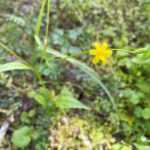
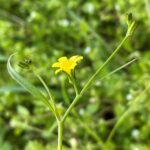
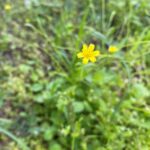
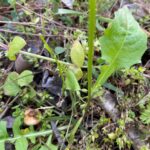
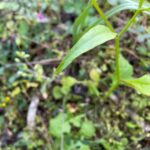
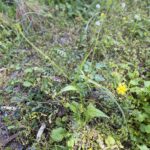
Ραγαδίολος ο εδώδιμος
Etymology of Rhagadiolus edulis: The name of the genus, "Rhagadiolus", is a Latinized word coming from the Ancient Greek word "ῥαγάδιον" [raghadion], meaning "of the small slit, small crack" + the Latin suffix "-olus" (meaning small), referring to a small flower, of which the rays of the calyx of its fruits, which are dug in a gutter, resemble a slit. Latin "edulis" means "edible" because it is indeed an edible plant being consumed in some regions until nowadays.
There are two Rhagadiolus taxa in the wild Cypriot habitat, two species.
Rhagadiolus edulis is said to appear all around the island except for the vast, central plains surrounding the capital. It is a plant that can be encountered up to an altitude of 1475 metres. Its flowering period is between March and June.
Rhagadiolus edulis has a tiny flower head of 5 to 8 mm, and linear-cylindrical or slightly curved outer fruit achenes.
Rhagadiolus stellatus has a flower head exceeding 1 cm in diameter and curved outer fruit achenes.
| Cookie | Duration | Description |
|---|---|---|
| cookielawinfo-checbox-analytics | 11 months | This cookie is set by GDPR Cookie Consent plugin. The cookie is used to store the user consent for the cookies in the category "Analytics". |
| cookielawinfo-checbox-functional | 11 months | The cookie is set by GDPR cookie consent to record the user consent for the cookies in the category "Functional". |
| cookielawinfo-checbox-others | 11 months | This cookie is set by GDPR Cookie Consent plugin. The cookie is used to store the user consent for the cookies in the category "Other. |
| cookielawinfo-checkbox-necessary | 11 months | This cookie is set by GDPR Cookie Consent plugin. The cookies is used to store the user consent for the cookies in the category "Necessary". |
| cookielawinfo-checkbox-performance | 11 months | This cookie is set by GDPR Cookie Consent plugin. The cookie is used to store the user consent for the cookies in the category "Performance". |
| viewed_cookie_policy | 11 months | The cookie is set by the GDPR Cookie Consent plugin and is used to store whether or not user has consented to the use of cookies. It does not store any personal data. |